Schmetz
C
C. Damage to the material and the solution

Product features
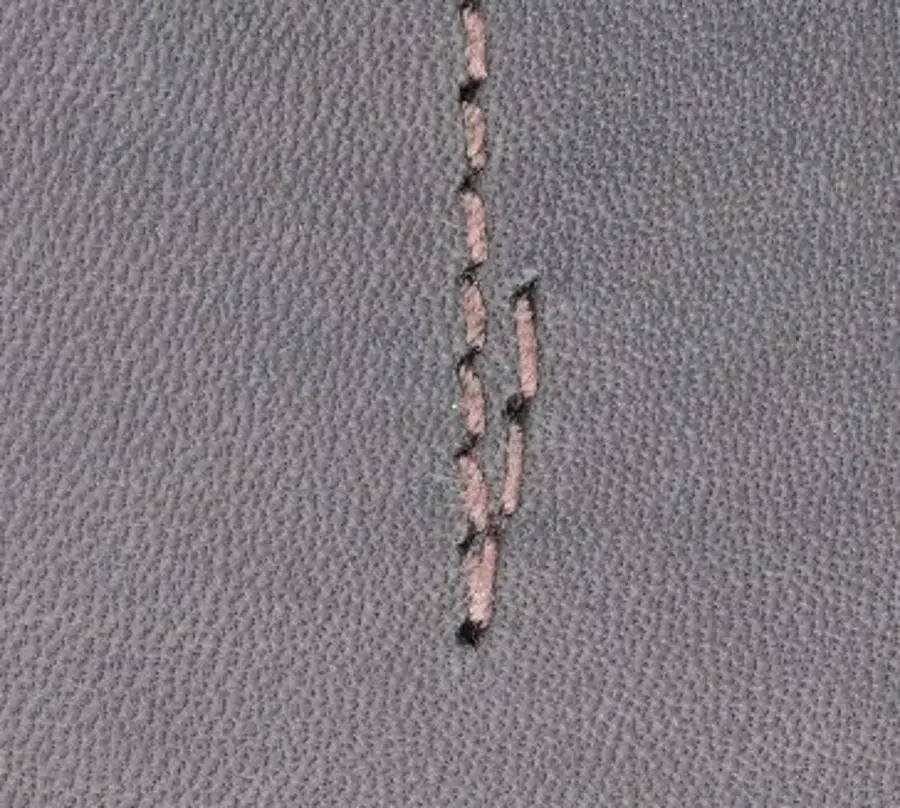
In vehicle seats production damage to the material is a frequent problem. Besides the use of too large needles for sewing, another main cause of damage is the use of unsuitable needle point styles.
SCHMETZ has two main point styles to prevent material damage: Round/ball points and cutting points.
The following ball or round points are available for you to choose from:
For this case SCHMETZ has the solution: Round and ball points R , SES and SUK
The round point R is the standard point shape with a wide range of use. However, if damage occurs as a result of piercing fabric threads, especially in knitted articles, it is recommended to use the points SES or SUK.
Applications in the manufacture of vehicle seats:
R:
Woven fabrics and foam backing · Material combinations · leather qualities, which can be pierced with the R point without any problem
SES: Fine to medium knitwear and foam backing
SUK: Coarse knitwear and foam backing
The advantages of the ball points SES and SUK:
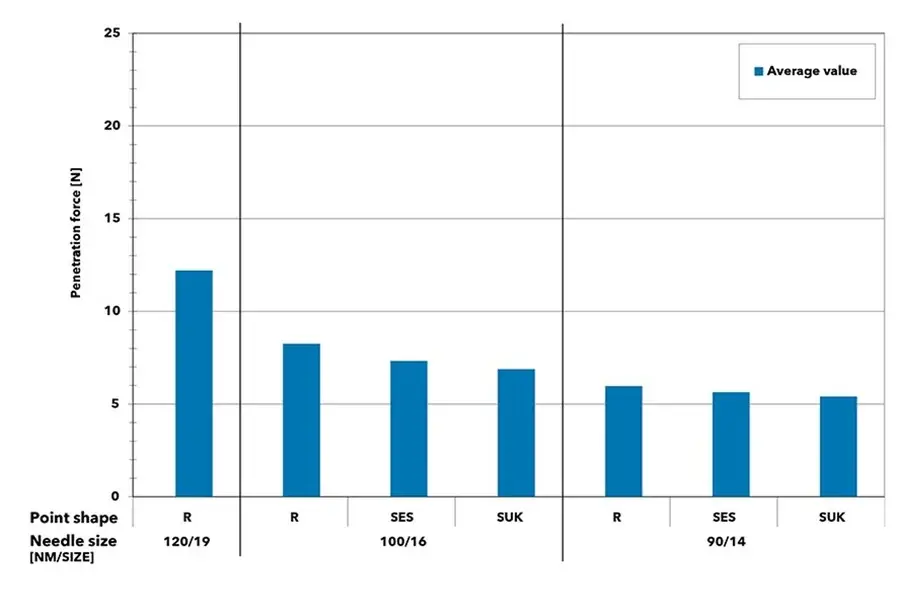
Increased displacement effect compared to the R point · Less penetration force than the R point
The denser the fabric and the more layers which have to be sewn together, the less space there is for the needle to pierce between the fabric threads and the higher the risk of the needle "piercing" a fabric thread.
If a fabric thread is "pierced", either the entire thread or several fibers are damaged. This damage may not be recognizable with the bare eye. But with mechanical stress this damage becomes worse and more obvious. Therefore the displacement effect of the ball point is more effective and important the smaller the gaps between the individual fabric threads are. Another "side effect" of piercing the gaps between the fabric threads is reduced penetration force, which results in less needle breakage especially when many layers of material are being sewn.
A comparison of different needle sizes shows that the penetration forces of thinner needles are much lower. This correlates with less damage to the material and, due to the lower friction, also minimizes thermal damage. The penetration forces of ball points are also less than those of normal round points.
Advice: We recommend to replace the needles after each shift change – or at shorter intervals if they are subjected to a lot of stress – in order to prevent material damage caused by defective needle points.
Tip: You get smaller stitch holes and less material damage with the same needle stability if you choose one needle size less in the SERV 7 design instead of a standard needle.
Requirements for cutting effects and seam appearance
In vehicle seat production composite materials are often used – such as laminated material together with plastic profiles and also leather. This is where needles with cutting points are recommended. These special needles pierce the material easier because of their cutting properties with reduced needle temperature. SCHMETZ offers a large range of different cutting points. The choice of the optimum point style depends on the thickness of the material, the type and function of the seam as well as the intended appearance of the seam. The incision and seam appearance vary depending on whether the cross section of the cutting edge has a lens-shaped, diamond or triangular shape. Another aspect is whether the cutting edge is across, at an angle or in the sewing direction.
For this case SCHMETZ has the solution: Special cutting points
Reverse twist point "LR" · Twist point "LL" · Narrow cross point "S" · Narrow wedge point "P", "PCL" and "PCR"
The cutting points LR , LL , S , P , PCL and PCR are point styles suitable for all kinds of leather used in the vehicle seats industry. The main reason to use one of these cutting points is to create a special seam appearance .
Application of the cutting points LR, LL, S, P, PCL and PCR in the vehicle seats industry:
These point styles are suitable for all kinds of leather used in the vehicle seats industry. · The LR point is used when a decorative seam appearance is desired with stitches slightly inclined to the left. A stitch density of up to 5 – 6 stitches/cm is possible. · The LL creates a more resistant seam than the S point with straight stitches that are slightly drawn in. The stitches are slightly more irregular than those of an S point. A stitch density of 5 – 6 stitches/cm is possible. · The S point produces a very straight seam line. The sewing thread is drawn into the leather. The S point is used often to create coarse decorative seams where thick sewing threads and large stitch lengths are used. Due to the incision in seam direction the stitch density should not be less than 3 – 4 stitches/cm to prevent seam perforation. · The P point is used for seams that are subject to great strain. A stitch density of 6 – 8 stitches/cm is possible. · The PCL and PCR should be selected to protect the sewing thread if strong, hard leather is being sewn. The PCL must always be used where the needles are threaded from the left. The PCR is used particularly as a left needle in two-needle machines.
For this case SCHMETZ has the solution: Special cutting points
SCHMETZ offers you three different types of triangular cutting points with graduated cutting effects for vehicle seat production. All three create a seam with straight stitches.
Triangular point D · Half triangular point DH · Round point with small triangular tip SD1
Application of the cutting points D, DH and SD1 in the vehicle seats industry:
Needles with a triangular cutting point D are used where dry, hard leather has to be sewn successfully and economically and especially in combination with plastic profile or cardboard, if the plastic or cardboard is particularly solid. The stitch density should not exceed 3 – 4 stitches/cm · The round point with small triangular tip SD1 is suitable for sewing material combinations with softer plastic material. A stitch density of up to 6 – 8 stitches/cm is possible · The SD1 is also suitable for multidirectional sewing of leather, because the stitch appearance remains the same in all sewing directions. · The harder the material to be sewn the more cutting effect is necessary: SD1 point with approx. 10 % cutting effect, DH point with approx. 50 % cutting effect, D point with approx. 90 % cutting effect
Tip: If high needle stability is required we recommend the SD1 point in combination with the SCHMETZ SERV 7 design. The reinforcement of the blade minimizes needle breakage and the hump scarf prevents skip stitches.
Note: The more the cutting effect increases, the more you are faced with damage to the sewing thread or material with starting and finishing bar tacks. The bar tacks should not be on the seam line but at a slight angle to the seam.
Advice: Depending on the material structure and the number of layers, round or ball points should be used for mainly textile materials. Cutting points are mainly suitable for leather, but also for different material combinations with plastic or cardboard. However, it must be considered that the cutting point could damage the textile components of the material. For optimum choice the point style should be adjusted individually in tests on the specific material or material mix and the specific processing technique.
Information: Special needle systems 134-35 FL SERV 7 and 134-35 FK-E SERV 7 in the vehicle seats industry
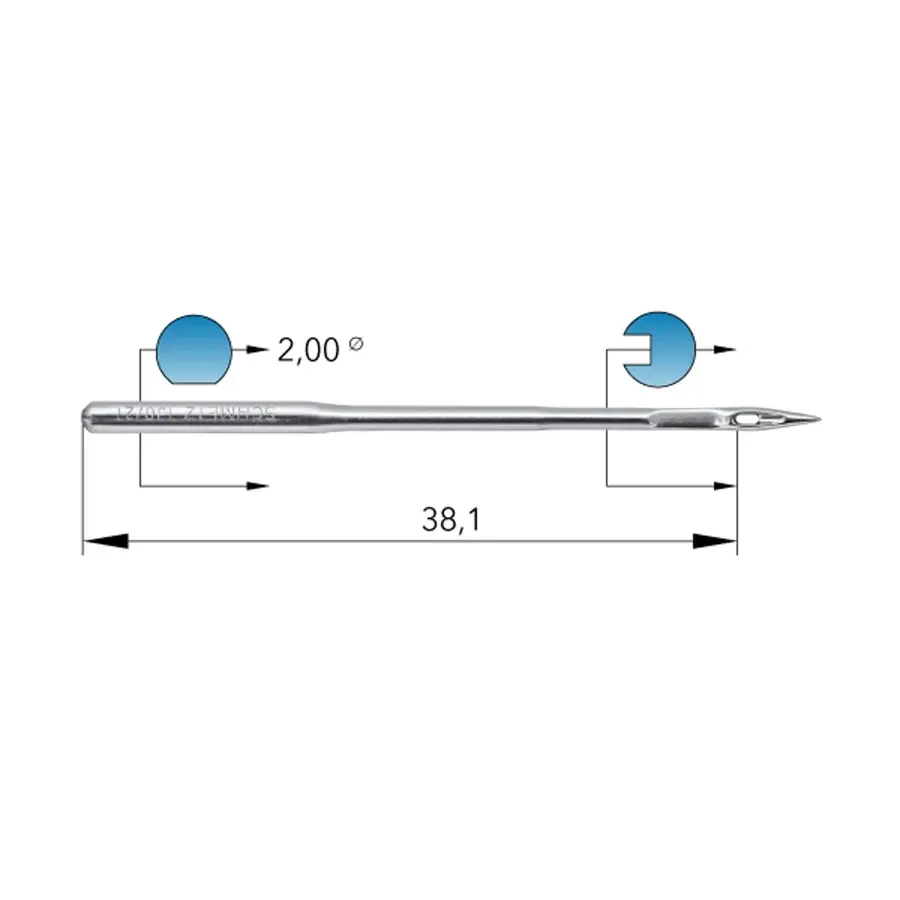
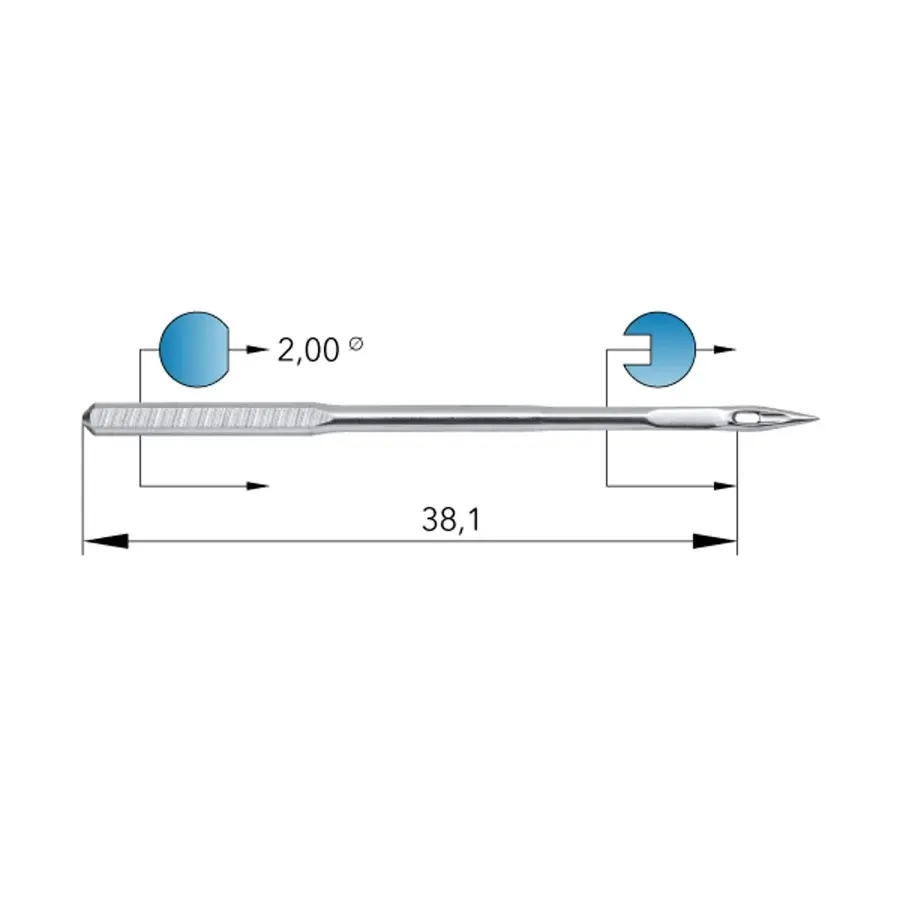
SCHMETZ has a special variant of the 134-35 needle system, which is most commonly used in seat production: the flat shank range. These needles have the prefix FL or FK-E and are supplied in a SERV 7 design.
Advantages of the 134-35 FL SERV 7 and 134-35 FK-E SERV 7:
Due to the flattened shank, the needle is always fixed in exactly the same position in the needle bar and that cannot be inserted at an angle. This ensures the required reproducibility and the seams are produced with a consistent high quality.

Catalogue
The C documents Schmetz publishes, on their own site. They open in a new tab.
And the catalogues Schmetz publishes for their whole range.
The file is published and updated by the manufacturer; it is not copied here, so nobody downloads an outdated version.
Data sheets, photos, videos and specifications: Schmetz.
Tell us the operation you need to solve and we will reply with the right configuration and the lead time.