
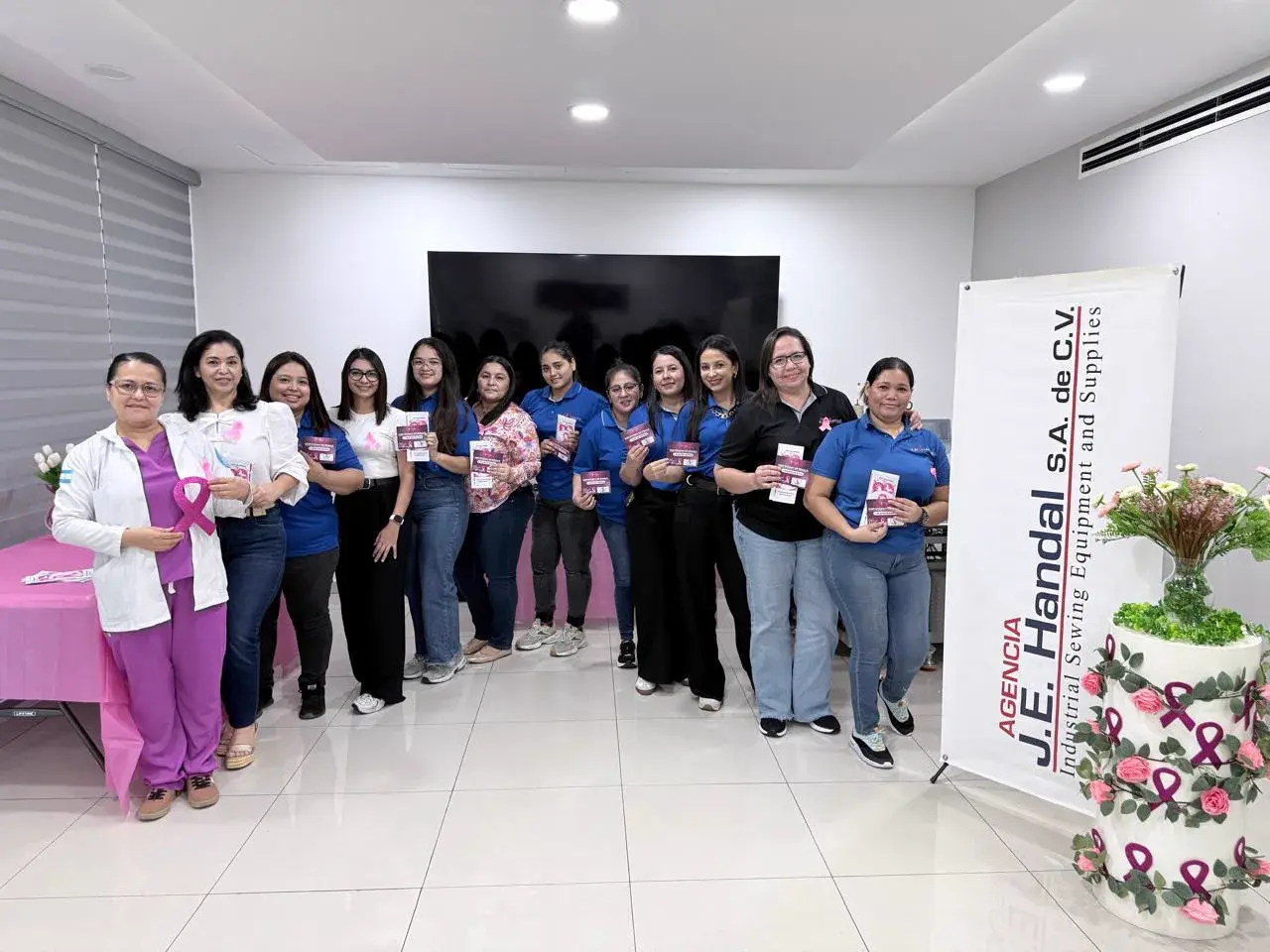
October is breast cancer awareness month, and Agencia J.E. Handal marked it with its people. On Monday, October 27, in the company showroom, all of its women employees took part in a prevention talk under the motto of this year's campaign: “Prevention is in our hands.”
A talk with a demonstration
The talk was given by Dr. Vanessa Argueta, the doctor at the Zoli J.E. Handal plant, a group company. She went over the risk factors, explained what a mammogram is for and showed how to do a breast self-exam, with a demonstration in front of the attendees.
- Breast self-examination, with a demonstration.
- Mammography.
- Risk factors.
The message is simple: knowing your own body and catching it early makes the difference. Attendees took home information leaflets and the pink ribbon, the symbol of this cause.
A pink ribbon made of people
The campaign also brought together the group's companies: Zoli J.E. Handal, Químicas Handal, Dicentro, NovaLace, Montecarlo and Agencia J.E. Handal. Their people came together to form a giant pink ribbon, captured from the air in the video.
Breast cancer in the Americas
According to the Pan American Health Organization, the Americas recorded more than 525,000 new breast cancer cases in 2022, almost a quarter of the world's total. Latin America and the Caribbean saw more than 220,000 diagnoses and almost 60,000 deaths that year.
In the region it also comes earlier: 31% of the women affected in Latin America and the Caribbean are under 50, a much higher share than in North America. And about half of all cases occur in women with no identified risk factor. That is why prevention concerns every woman.
The signs to know
PAHO advises seeing a health professional as soon as possible if you notice any of these signs:
- A lump in the breast, even if it is painless.
- Thickening of the breast.
- Changes in its size, shape or appearance.
- Skin changes: redness, pitting or dimpling.
- Changes in the nipple or the areola.
- Abnormal nipple discharge.
Up to 90% of breast lumps have other causes, but every one of them needs a full medical evaluation.
Catching it early
Where resources allow, PAHO recommends a mammogram every two years for women aged 50 to 69; where they do not, a clinical breast exam is a viable option. The risk factors it lists include obesity, alcohol and tobacco use, a family history of breast cancer, radiation exposure, and reproductive and hormonal history.
In high-income countries, breast cancer mortality fell by 40% between 1980 and 2020. The invitation is the campaign's own, and it holds all year round: prevention is in our hands.